
Garfield County Court Docket Searches
For a Garfield County court docket search, start with Utah Courts Xchange, the statewide portal for District and Justice Court case information. Garfield County runs no single database of its own. That means you pick the right court first. District Court handles felonies, Class A misdemeanors, ordinary civil suits, domestic cases, probate, and other general-jurisdiction matters. Traffic cases, infractions, Class B or C misdemeanors, local ordinances, and small claims belong to Justice Court. Juvenile matters stay out of the ordinary public search.
A case number opens doors fast. It is not unique across Utah, though, so pair it with Garfield County, the Panguitch location, and the correct court type. Name searches work better with the wildcard Xchange help describes, like a last name followed by an asterisk. A citation number also needs its court or citation location. One caution: broad statewide name searches can hit the portal's result cap.
- Identify whether the matter belongs in District, Justice, Juvenile, appellate, or federal court.
- Open Xchange and choose all cases or a judgment-only search.
- Enter the case number, or use name and company fields with a wildcard where needed.
- Narrow the scope to Garfield County and the correct Panguitch court location.
- Check case type, filing date, parties, and court before opening the case history.
- Save the case number and exact entry date before requesting a document from the clerk.
Remote Xchange use bills per search, so read the billable-search notice before you submit anything. A terminal at the courthouse may be free instead. If neither route pans out, the right clerk can tell you where to send a focused written record request.
Court Dockets: What They Show
Think of a Garfield County court docket as a case diary. It is not the full file. The first entry might be a complaint, petition, information, citation, or small-claims filing. From there, rows add more. They can show service, motions, hearing settings, orders, judgments, disposition, payment events, and appeal activity. Read carefully, though. A line saying a motion was filed is a request, not a ruling. The order itself controls that question.
An Xchange result page names the court location. It can also identify the county, case type, case number, filing date, party role, and access to history or documents. Criminal and traffic summaries may list charges, pleas, citation details, and dispositions. Civil records may show plaintiff or petitioner roles, counsel, service, hearings, judgment, dismissal, or satisfaction. Private data can be redacted. Some public entries have no downloadable image.
| Case number | The court identifier, paired with location and case type. |
|---|---|
| Case history | The dated register of filings, settings, court acts, and results. |
| Party code | An abbreviated role such as plaintiff, defendant, petitioner, or respondent. |
| Setting | A scheduled court event, not proof that the hearing occurred. |
| Disposition | The stated resolution of a claim, charge, or whole case. |
| Document link | An available electronic filing that may require a separate purchase. |
Garfield Case History and Calendar
Three tools, three jobs. Xchange case history shows what has been entered in a Garfield County case. The court calendar shows what is scheduled. It covers a limited date range. A filed document supplies the actual text of a motion, order, or judgment. Treat them as interchangeable and you can reach a wrong conclusion.
- Case history
- The dated docket record of case activity in CORIS and Xchange.
- Calendar
- A forward-looking list of scheduled events that may later move or be canceled.
- Filed document
- The pleading, order, or other paper behind a docket entry, when public and available.
- Certified copy
- A clerk-authenticated copy requested for a use that requires official certification.
Once a scheduled date passes, check the history for a minute entry, continuance, order, failure-to-appear entry, or disposition. If a calendar and a notice conflict, call the correct clerk before relying on either.
Garfield County Courts and Dockets
Garfield County sits in Utah's Sixth Judicial District along with Kane, Piute, Sanpete, Sevier, and Wayne counties. The Garfield County Courthouse in Panguitch holds three operations. Under one roof are the Sixth District location, Garfield County Justice Court, and Panguitch City Justice Court. Shared walls do not merge case histories. You still have to choose the exact court before running any docket search.
Where do appeals go? Justice Court appeals generally start in District Court. District and Juvenile Court appeals go further. They may reach the Utah Court of Appeals or Utah Supreme Court, depending on the case category. An appellate case carries its own docket, searched apart from the original trial record. Federal matters arising from Garfield County take another path. They fall to the District of Utah's Southern Region and never appear in Utah Xchange.
Docket flow: Local Justice Court › Sixth District Court › Utah appellate courts. A general trial case begins in Sixth District Court and follows the appellate route assigned by state law.
One Courthouse, Separate Garfield Clerks
The clerk split matter as much as the court split. Jennifer Miller, Deputy Court Clerk, is the listed contact. She is the District Court contact for Garfield County civil, domestic, probate, felony, and related district records. Seirra Julander, Justice Court Clerk, covers both Justice Courts. She handles Garfield County Justice Court and Panguitch City Justice Court traffic, infraction, local misdemeanor, ordinance, and small-claims records.
County administrative records are a different animal. The Garfield County Auditor-Clerk keeps those. Its GRAMA process may fit a county contract, meeting record, budget, or planning document. It is not a substitute. A Judiciary request goes to the court that keeps the docket. Naming the exact custodian saves time and keeps private details out of a broad request.
Sixth District Court Clerk
55 South Main Street
Panguitch, UT 84759
Mail: PO Box 77
435-676-1104
Monday-Friday, 9 a.m.-noon and 1-5 p.m.
Garfield Justice Court Clerk
55 South Main Street
Panguitch, UT 84759
Mail: PO Box 77
435-676-1115
Monday-Friday, 8 a.m.-noon and 1-5 p.m.
Court Dates and Settings in Garfield County
The official Utah court calendar lists scheduled District and Justice Court activity over a two-week period and is updated daily. Search by the correct court and location. A calendar row may show the parties, case number, judge, hearing type, date, time, and remote or courtroom detail. Some entries include a WebEx link. Garfield County says hearings other than trials can be attended through WebEx. But remote access is not automatic for every event. If a link is missing, contact the judge team or court location.
Access has limits. Private, sealed, juvenile, victim-sensitive, or judge-restricted proceedings may be closed or partly limited. Never share a restricted meeting link. A reset or continuance moves the event; it does not dismiss the case. For anything time-sensitive, confirm the setting with the clerk. Do it especially when the docket, notice, and calendar appear to differ. The full search sequence is on the Garfield County court schedule page.
When Garfield Docket Search Fails
A blank screen does not mean the case is gone. Before giving up, try again. Run the search with a different court level or a different county choice. Use another spelling of the name, or a wildcard. Check the Panguitch location setting, the case type, the citation number, and the filing date too. A fresh citation may simply not be in the system yet. Older Justice Court matters can predate the local CORIS conversion, and some paper filings were never scanned at all.
Some records sit outside public view by law. Juvenile, adoption, civil mental-health, expunged, and sealed files are excluded or restricted. Family and guardianship cases may show a public outline. Petitions, financial statements, medical papers, temporary orders, and other protected filings stay hidden. Ask the clerk for a public history, an order, a judgment, or a redacted abstract. Do not assume a hidden item can be opened.
No match: Save the search terms and time, try the other correct court level, then call the clerk with the case or citation number, party role, date, and exact record sought.
Docket Access Under Utah Law
Utah law starts from openness. Utah Code of Judicial Administration Rule 4-202.02 presumes court records are public unless they fall into a private, protected, sealed, or otherwise restricted class. A companion provision, Rule 4-202.03, says who may inspect each class. So a public Garfield County docket can sit beside a hidden filing, a redacted identifier, or a restricted attachment.
Want a specific court record? Use Rule 4-202.04 together with the Utah Judiciary Request for Record form. The Judiciary normally answers within ten business days. GRAMA covers county-held government records. The state's Government Records Access and Management Act cannot override court classifications or a sealing order.
Access boundary: A party or authorized person may have a lawful route through MyCase or a documented request. Anonymous public access does not extend to every filing.
Free and Paid Garfield Access
Remote Xchange access costs money. Expect a charge per search. Any document you pull costs extra, no matter the page count. Read the case history carefully before buying a PDF. The title and date should match the filing you actually need. Not every historic filing has been digitized, either.
Free options matter in a large rural county. Utah Courts says public Xchange terminals sit at most District Court sites and may exist at some Justice Courts. Call the Garfield County courthouse before driving over to confirm the terminal and its hours. The Utah State Law Library offers another public-access route. Looking at an available public court record is generally free, though copies, certification, staff research, media, transcripts, or delivery can add cost.
The MyCase service is free for parties and authorized users. It can show filed papers, notifications, payments, linked cases, and hearing links. It is not anonymous public Xchange. And eFiling exists to submit papers, not to run a general public docket search.
How the Clerk Keeps Docket Records
Court staff type case data into CORIS. Xchange displays the public information after local entry. Timing varies with the filing, the clerk's workflow, and system availability. A new paper, minute entry, hearing result, or disposition may not appear right away. Closed and disposed cases stay public unless sealing or expungement changes access.
Clerks wear many hats. They receive filings, keep the chronological history, issue notices and certified copies, coordinate calendar records, and apply access classifications. Ask them about a form, a payment path, or a deadline shown in the record. Ask how to make a request. They cannot pick a plea or choose legal strategy. They cannot interpret an order as counsel, or remove a public case just because someone asks informally.
Chasing an older paper file? Bring the case number, the court, the document title, and the filing date. Say whether you want inspection or a plain copy. The same request can cover a certified copy, a transcript, audio, or video. A narrow request lets the Garfield County clerk search without guessing.
Garfield Court Access Then and Now
The historic courthouse dates to 1907. A county planning document describes an addition that joined the older building and jail, with one courtroom shared by Sixth District Court, Garfield County Justice Court, and Panguitch City Justice Court. That crowded physical setup explains something today. One address can lead to three distinct docket systems.
Panguitch City Council minutes from 2024 lay out an approximately $8 million remodel covering seismic work, the roof, abatement, windows, sprinklers, and HVAC.
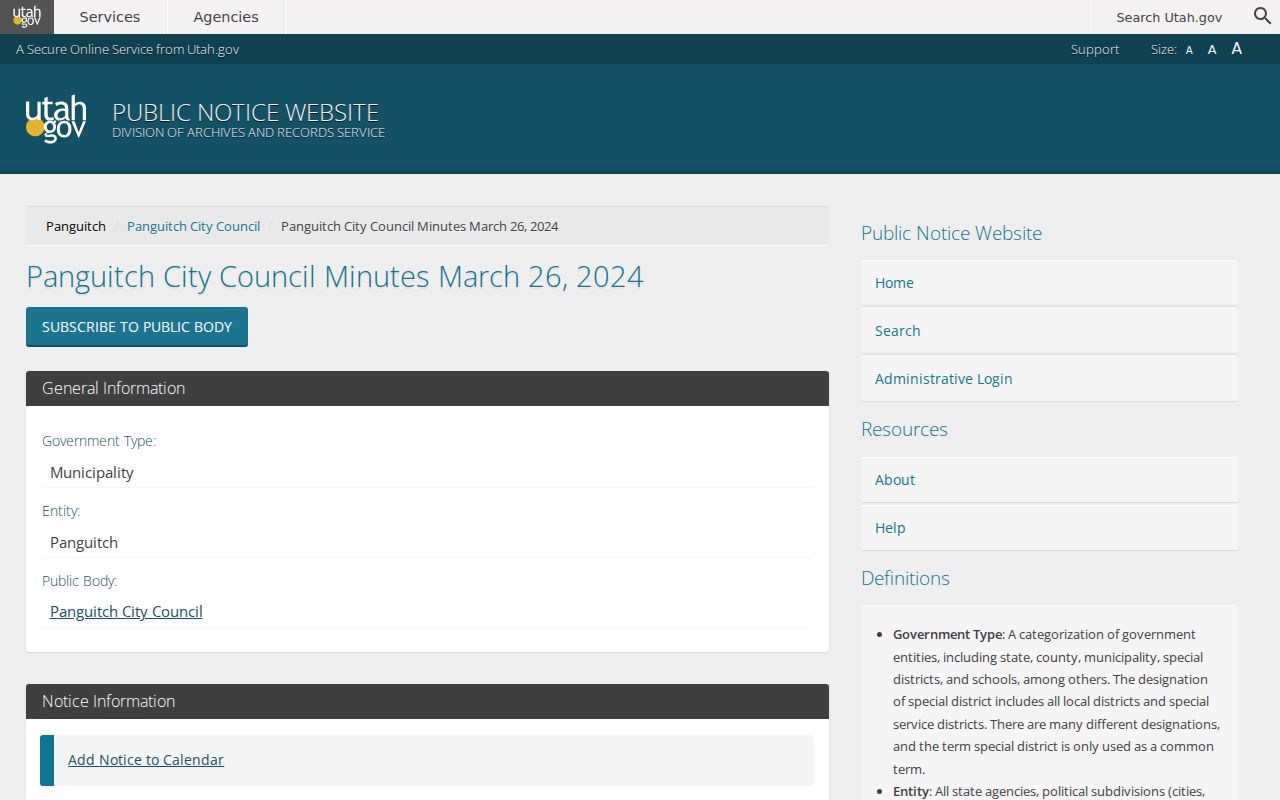
The minutes set project scope only. They promise no open counter and no finished phase. Call before travel. Access today runs through CORIS, Xchange, eFiling, MyCase, public terminals, and WebEx, yet the clerk still keeps the official record.
Garfield Court Workload in Context
Traffic drives the local Justice Court docket. Utah's fiscal 2026 third-quarter pending report counted 336 Garfield County Justice Court matters. Of those, 314 were traffic or parking cases. The fiscal 2023 report listed 2,117 filings and 1,995 dispositions for that same court. Panguitch Justice Court recorded 177 filings and 170 dispositions in that report.
These snapshots cover different periods and different measures. They cannot predict how long one Garfield County case will take. They do show why a traffic citation usually belongs in the Justice Court search first, while a felony or an ordinary civil suit still calls for the District Court.
City-by-City Court Dockets in Garfield County
The 2020 Census incorporated-place table names Garfield County's five largest incorporated places. These are Panguitch, Escalante, Tropic, Bryce Canyon City, and Boulder. A city address alone tells you nothing about the court. Panguitch has a listed city Justice Court. The other four places show no separate current municipal courts. Read the citation and verify the named court before searching. The official Garfield County city and town list gives the local-government cross-check.
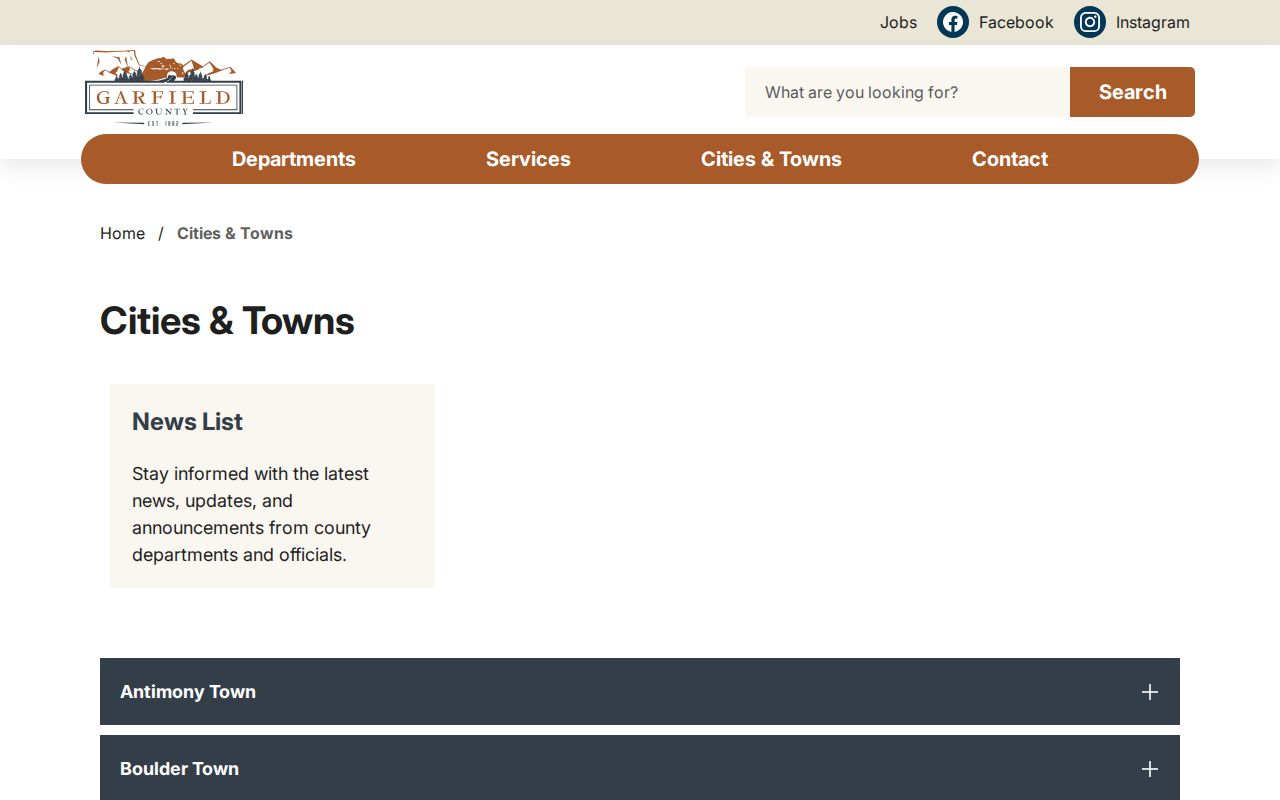
Each city record page below separates town and city records from the Utah court record route.
Panguitch Court Records
County seat and location of three separately kept trial dockets.
Escalante Court Records
Current county Justice Court routing after the former city court's consolidation.
Tropic Court Records
Town records use the recorder; court cases route through the named court.
Bryce Canyon City Court Records
Visitor citations require the court and location printed on the ticket.
Boulder Court Records
Remote search and focused written requests reduce unnecessary travel.
Inside Garfield County Xchange Access
The Xchange entry screen is the front door to a Garfield County docket search. Guest access lives on one part of that page. Payment, account setup, and subscriber login sit on separate parts of it. Once inside, the form asks for jurisdiction, search type, and a name or company. It also wants case type, scope, birth date when the law allows it, citation data, and date limits. Choose each option with care. Paying the search fee does not guarantee a match.
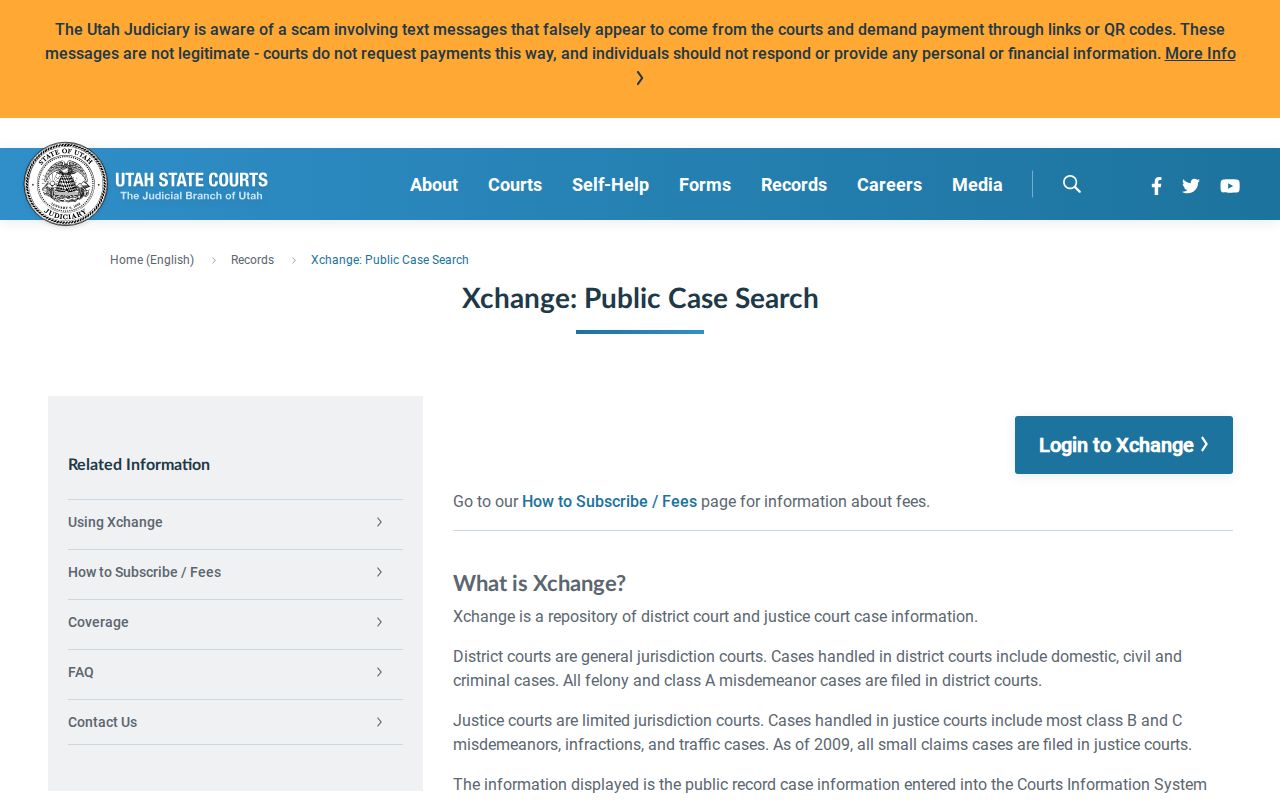
The official overview shows that Xchange pulls straight from court data, not from a separate Garfield County index. When a result opens, slow down. Compare the location, the filing date, the case type, and each party's role, and read the full history before you buy any public document. Too many results? Go back to the form. Narrowing the county, court, date range, or case type will shrink the list fast.
Map and Directions to the Garfield County Courthouse
Sixth District Court cases for Garfield County, including felonies, civil, domestic, and probate matters, are filed at the Garfield County Courthouse, 55 South Main Street in Panguitch. The 1907 courthouse's single courtroom is shared by the Sixth District Court, the Garfield County Justice Court, and the Panguitch City Justice Court, so the same address covers all three dockets even though each keeps a separate clerk and case file. A 2024 remodel addressed seismic, roof, mold/asbestos, window, sprinkler, and HVAC work at the building.
Sixth District Court Clerk
55 South Main Street
Mail: PO Box 77
Panguitch, UT 84759
435-676-1104
Monday-Friday, 9 a.m.-noon and 1-5 p.m.
No official source documents visitor parking, security-screening specifics, or a current accessible-entrance description for this courthouse, so calling the clerk before a visit is the safer plan. The Sixth Judicial District is Utah's largest by geography, spanning Garfield, Kane, Piute, Sanpete, Sevier, and Wayne Counties, so confirm the assigned judge and courtroom before traveling.