
Garfield County Civil Docket Searches
Utah Courts posts remote public civil case information through Utah Courts Xchange. District Court covers contract, tort, property, probate, and domestic matters. Justice Court takes small claims and other limited local cases. Set the search to Garfield County. You can also pick the Panguitch location. That stops a statewide name sweep from burying the useful docket entry. Enter names as they were filed. The official help suggests wildcards. Examples include LastName* and John*. Try them when a suffix, middle initial, or spelling variation may be present.
- Choose District Court, Justice Court, or both based on the civil claim.
- Select all cases or judgments only.
- Enter a case number, or the filed party or company name.
- Narrow to Garfield County, case type, and a useful date range.
- Confirm the court, party role, filing date, and case history before buying a document.
Parties can track supported matters and notices through MyCase. When the remote tools fall short, the clerk counter, a phone call, the courthouse terminal, and a written Judiciary request still reach the public court record.
Garfield County Civil Court Split
Kind and scale of the dispute decide the court. In Garfield County, the Utah District Court, Sixth Judicial District, serves as the general-jurisdiction civil court. Small claims stay with the Justice Court. One building may hold two separate civil dockets and two clerk functions.
| Path | Typical Garfield County matters | Appeal route |
|---|---|---|
| Sixth District Court | Contract, tort, property, domestic, probate, administrative appeal | Utah appellate route depends on the case |
| Garfield County Justice Court | Small claims and local limited-jurisdiction matters | Small-claims appeal begins in District Court |
The District Court overview shows its general civil jurisdiction.
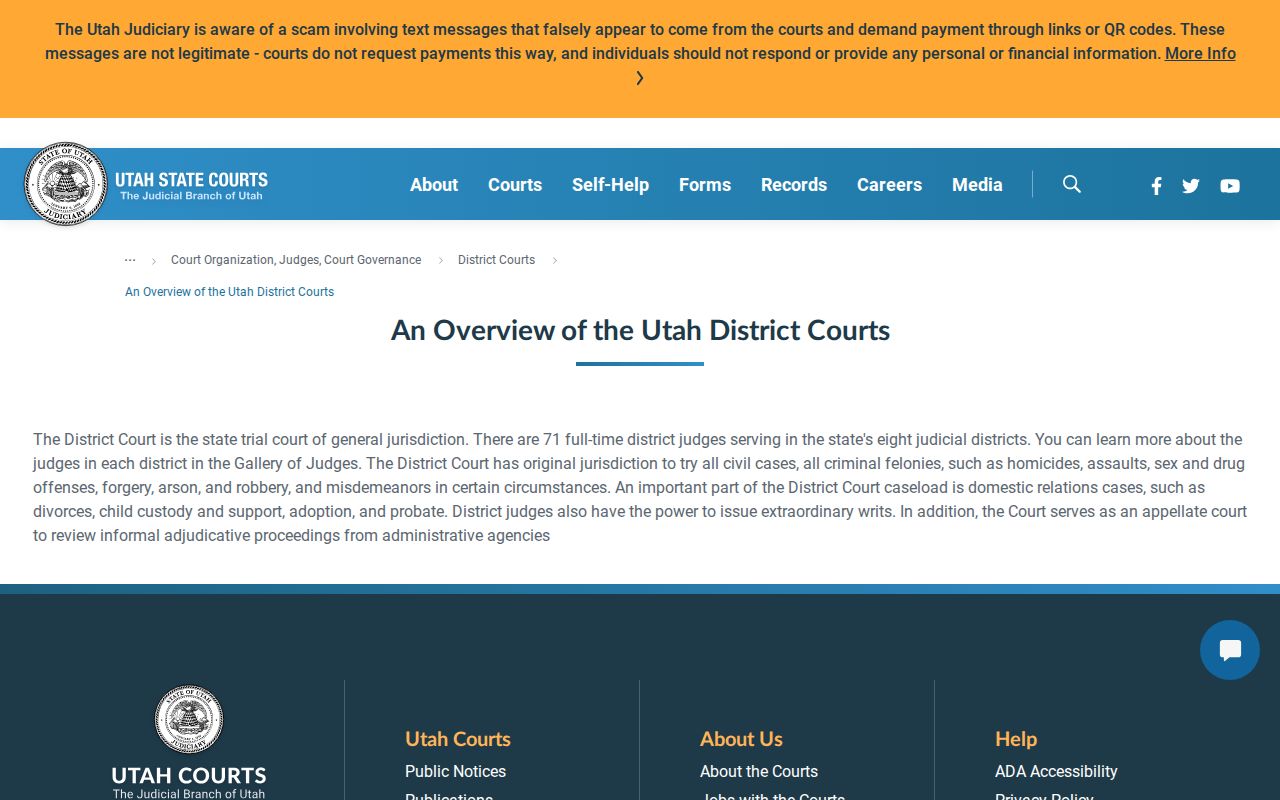
Settle the court-level question first, before running any Garfield County civil docket search.
Civil Dockets: What They Show
Think of a Garfield County civil docket as the clerk's running timeline. One line may show how a lawsuit began. Another records whether service went out. The docket also tracks motions as they are filed and notes when a hearing was set, plus how judgment or dismissal eventually came down. Keep one caution in mind. A docket line is only a summary, and it does not always match the full document sitting behind it at the clerk's office.
| Case header | Court, case number and type, filing date, status, and assigned judge |
|---|---|
| Parties | Plaintiff or petitioner, defendant or respondent, counsel, and public roles |
| Early events | Complaint or petition, summons, service, answer, and default entries |
| Litigation | Motions, responses, replies, scheduling, mediation, settlement, and orders |
| Outcome | Judgment, dismissal, appeal, execution, garnishment, payment, or satisfaction |
Read money lines with care. A judgment amount listed on a Garfield County civil docket proves only what the court entered, not what a debtor still owes. Later entries for satisfaction, payment, appeal, or an amended judgment can change the whole picture.
Garfield County Small Claims Docket
Small claims cases begin in Justice Court. Garfield County's own court page sets a limit up to $11,000. Utah's current fee schedule, though, lists filing tiers reaching $20,000. Those two official sources disagree. Before you file a claim anywhere near either figure, call the Justice Court and confirm the current jurisdictional limit for your small claims docket.
| Claim shown on state fee page | Current listed filing fee |
|---|---|
| Up to $2,000 | $60 |
| More than $2,000 and less than $7,500 | $100 |
| $7,500 through $20,000 | $185 |
| Small-claims notice of appeal | Additional $10 to Justice Court |
Fees shift over time, so confirm costs on the current Utah court fee page before you file anything in a Garfield County small claims case. On the docket itself, expect entries for the complaint, service, the hearing, judgment, payment, and any appeal. The clerk can walk you through the mechanics, though not the legal strength of your claim.
What Cases Fill the Civil Docket
The Garfield County District Court docket carries the ordinary civil suits: contract disputes, tort claims, and property fights. Domestic relations, probate, and administrative appeals land here too. Small claims, by contrast, belong to the Justice Court. To tell which track you are viewing, read the caption and the case type listed on the entry.
Not everything in these court records is open. A probate or guardianship file might show appointment letters, due dates, and orders in public view while keeping inventories, medical details, or protected account data closed. A domestic case may put only a sliver of history or a single hearing on the public docket while sealing the pleadings. Protective orders and parentage matters get similar special handling.
Read search results field by field. The code "PLA" means plaintiff and "DEF" means defendant, while "PET" marks a petitioner and "RES" a respondent. Those labels place each party in the case. They say nothing about who is right.
Garfield County Civil Docket Terms
A handful of docket entries signal big turning points in a civil case. Work through them in date order, and watch for later lines that soften or undo an earlier event.
- Complaint
- The paper that begins a civil lawsuit and states the claim.
- Answer
- A responding party's formal reply to the claim.
- Default
- A procedural result that may follow when a required response is not filed.
- Judgment
- The court's enforceable decision, which may later be amended or appealed.
- Satisfaction
- An entry recording that a judgment obligation has been met to the extent stated.
A default entry can come before a default judgment, and the two are not the same thing. A judgment line does not mean a paid judgment either. Before drawing any conclusion about where the case stands, scan the Garfield County civil docket for execution, garnishment, payment, satisfaction, appeal, or any later order.
Hearings on the Civil Docket
A civil hearing on the Garfield County docket can take many forms. It might be a scheduling conference. It could also be a motion hearing, a mediation event, a bench trial, a jury trial, or a review. Don't assume it marks a fixed stage. A criminal arraignment or sentencing would. The case history and calendar should name the setting type where that information is public, so read the entry before drawing conclusions about where the case stands.
Utah's public calendar covers two weeks of scheduled District and Justice Court activity. The courts refresh it daily. Write down the date, time, court, judge, case number, and hearing type. Then return to the civil docket after the hearing date passes. A listed hearing is not a result. It can be continued, vacated, replaced by an order, or even held without any outcome appearing in the calendar.
For hearings other than trials, Garfield County allows attendance through WebEx. Use only the link tied to the correct case. It must match the correct date. If no link appears, reach out to the judge's team or the clerk for help.
Missing Garfield County Civil Filings
A docket line in Xchange is no promise. The paper behind it may not be for sale online. Complaints, motions, and orders sometimes stay off the portal for reasons of digitization or classification. The document is still in the court file. That gap is about availability, not loss.
Work from the case history first. Write down the exact document title and its filing date. Then contact the Garfield County clerk for the right court. Ask to inspect the filing or get a copy. A written route exists too: the Utah Judiciary Request for Record process. Include the case number, court, party role, document name, and date range. Inspection costs nothing, though copies and staff time may carry fees.
Keep the custodians straight: Garfield County GRAMA covers county administrative records. A pleading or judgment in a civil case is a Judiciary record requested from the court.
Garfield County Civil Filing Trail
Utah Courts eFiling takes submissions from account holders. It is not the public civil docket. Clerks enter case information into CORIS. Xchange then shows public case history and whatever papers it carries. A filing can sit in one stage. The next stage may lag. So submission, clerk entry, history display, and document availability do not move together.
The April 2026 attorney FAQ notes that public documents eventually appear through Xchange. Filers must strip personal information before it lands in a public document. For a reader, search Xchange first and ask the clerk only for the specific item. Buying every PDF is rarely necessary. Check whether the case history already names the filing or order you need.
Garfield County Civil Docket Context
The FY2026 third-quarter pending Justice Court report listed one Garfield County general civil matter and one small-claims matter. Treat that as a dated snapshot. It is not an annual filing count, and today's docket may differ.
The Sixth District covers six counties. District-wide annual trends are therefore not Garfield County counts. Use the local numbers for context only, and run a current Xchange or clerk search for any specific case.
Who Can See Civil Dockets
Public civil case histories and judgments can be inspected, but not every filing is public. Utah classifications guard domestic, guardianship, protective-order, medical, financial, adoption, and mental-health material. So a docket line can stay visible while its exhibit or affidavit remains private.
CJA Rule 4-202.02 defines public, private, protected, and sealed classes. CJA Rule 4-202.03 states who may inspect each class. CJA Rule 4-202.09 governs certified copies.
Two clerks serve civil matters at one courthouse. Jennifer Miller is the Sixth District Court deputy clerk at 55 South Main Street, PO Box 77, Panguitch, Utah 84759. Reach her at 435-676-1104. Seirra Julander handles Justice Court business in the same building at 435-676-1115. Match the office to your civil case, and call ahead before you drive over.