
Boulder Court Docket Searches
Begin at Utah Courts Xchange, the official entry point for a Boulder docket search. It queries public District and Justice Court data entered in CORIS. Choose Garfield County, then the court or location printed on your paperwork. Do not assume Boulder shows up as a live court location, and remember that a case number or citation number is not unique across Utah.
- Select District Court, Justice Court, or both based on the case type.
- Choose all court cases unless a judgment-only result is the actual goal.
- Enter the case or citation number and add Garfield County and the named location.
- For a name search, use the filed name and the official wildcard guidance when a suffix or initial may vary.
- Open case history before buying any available document, then confirm an upcoming date with the clerk.
The paid guest route charges a one-time $10 account fee, $0.20 per search, and $1 per document. A free public terminal may sit at the courthouse. The Utah State Law Library also offers free public Xchange access.
Three Boulder Record Custodians
The Garfield County Courts directory lays out the current split. Boulder Town keeps only town administrative information. Garfield County Justice Court runs its own local docket, while the Utah District Court, Sixth Judicial District, holds the county's general-jurisdiction cases.
| Court | Typical Boulder record | First contact |
|---|---|---|
| Boulder Town | Town administration, notices, and local-government records | Town office |
| Garfield County Justice Court | County traffic, lower misdemeanors, small claims | Justice Court clerk |
| Sixth District Court | Felony, probate, domestic, and general civil case | District Court clerk |
These three custodians never merge their records. So read the court line on any result before trusting its chronology.
Inside the Boulder Municipal Court
The Utah Courts directory lists no separate current Boulder municipal court. The Garfield County Courts page shows the same. Check that point again whenever a citation leaves the court unclear. It does not mean a Boulder ordinance or local citation lacks a court route.
Seirra Julander serves as Garfield County Justice Court clerk. The office sits at 55 South Main Street, PO Box 77, Panguitch, Utah 84759. Call 435-676-1115. Hours run Monday through Friday, 8:00 a.m. to noon and 1:00 to 5:00 p.m., excluding holidays. Ask whether your Boulder matter belongs there.
Boulder Town and Court Records
The official Boulder Town site places the town office and community center at 351 North 100 East, Boulder, Utah 84716. Two numbers reach it: 435-335-7300 and 435-222-5480. Hours are limited to Tuesdays, 10:00 a.m. to noon, effective January 2026.
Call before making the drive. The town office handles local administration, though. It does not automatically hold a Utah court file. For case history, that official page gives context only. The courthouse channels remain the real route.
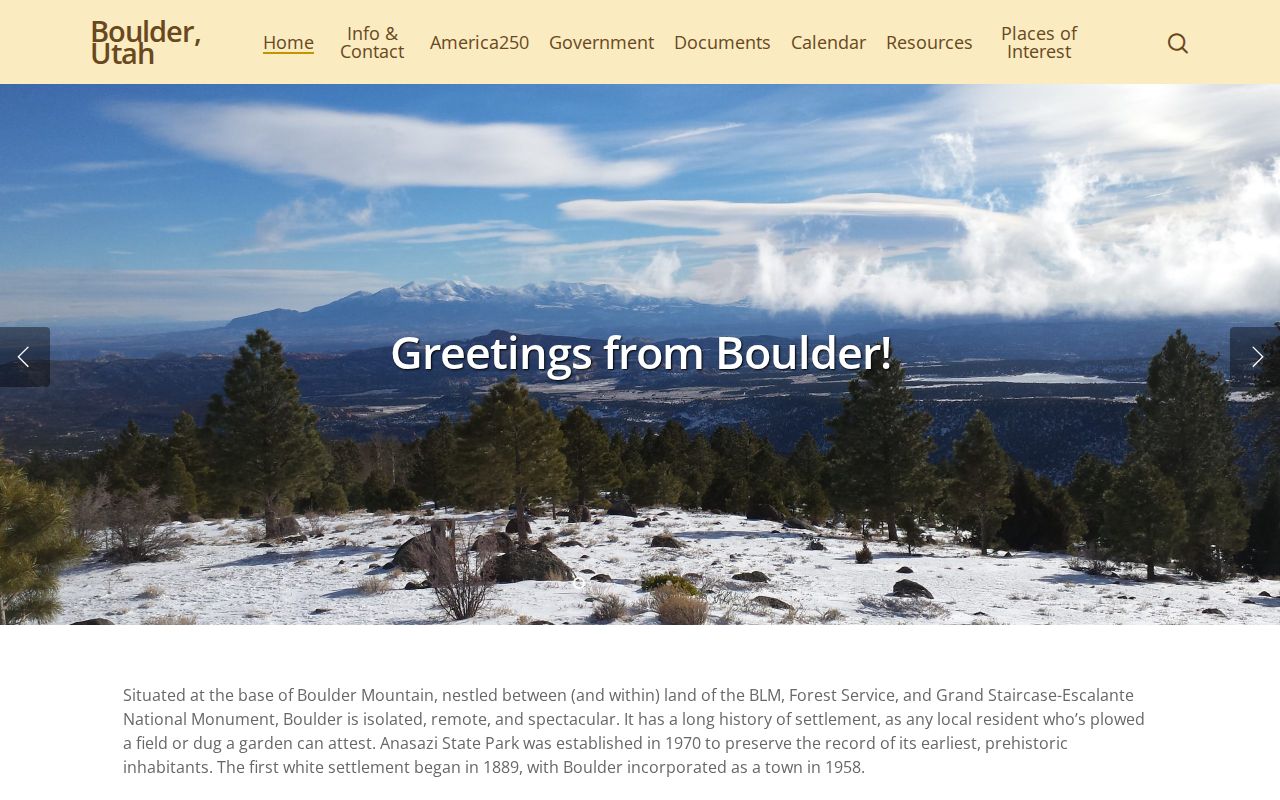
That is the town channel only. Xchange and the Garfield County clerks still supply court case history.
Finding Boulder Court Dates
The Utah court calendar is the official schedule, generally covering a two-week window updated daily. Pick the correct court type. Use the location named on the notice, often Garfield County or Panguitch. Remember, a calendar row only announces scheduled activity. It never proves the hearing took place. Compare it against case history, and call the clerk when instructions seem unclear.
| Date | The scheduled day, subject to later continuance or cancellation. |
|---|---|
| Time | The listed start time, which may be a shared docket call. |
| Courtroom | The courthouse room listed for the case or a remote-hearing designation. |
| Judge | The judicial officer assigned to the setting. |
| Setting Type | Arraignment, pretrial, trial, review, or another stated hearing type. |
Some entries include a WebEx link. Garfield County allows WebEx attendance for hearings other than trials, but the link tied to the actual case and date always controls.
Boulder Docket Scale and Distance
The U.S. Census Bureau counted 227 Boulder residents in its 2020 incorporated-place table. Small towns still generate court questions. Garfield County's Justice Court figures are countywide, and the FY2026 third-quarter report showed 314 pending traffic and parking matters in that court.
Those pending totals are countywide, not Boulder-only, and not live counts. That is why the case type and court filter matter more than town population. Search each known case in the current system.
Boulder Traffic Ticket Lookups
Read the citation first. It should name the court, citation number, alleged violation, response date, and issuing agency. In Xchange, select Justice Court and enter the citation number with its listed location. If nothing matches, try the party name. Then confirm whether the filing belongs to Garfield County Justice Court or another named court.
Respond, pay, or contest only through the court and method named for the matter. MyCase serves parties in supported case types. Utah ePayments serves some courts, but neither can be assumed from a generic city search. For county-wide procedure, see Garfield County traffic court records.
When Boulder Records Stay Hidden
A blank online result does not prove a Boulder case is absent. Several things explain the gap: the wrong court filter, a recently entered matter, an older paper file, a spelling difference, or a record classification. Juvenile, sealed, expunged, adoption, and civil mental-health records never appear in ordinary public Xchange results.
Practical next step: Call the Justice Court clerk for a traffic or lower-level case and the District Court clerk for a felony or general civil file. Give the court, case or citation number, party name, and date range.
For District Court, Jennifer Miller, Deputy Court Clerk, takes calls at 435-676-1104. District office hours are Monday through Friday, 9:00 a.m. to noon and 1:00 to 5:00 p.m., excluding holidays.
How Boulder Cases Reach the County
Jurisdiction decides the docket, not the spot where an event happened. Boulder Town keeps its own administrative records. Filed traffic, misdemeanor, infraction, and small-claims matters may belong to Garfield County Justice Court, while felonies, probate, domestic cases, and ordinary civil suits move through the Sixth District Court.
Docket flow: Boulder event › Named Justice Court › Garfield County District Court when jurisdiction or appeal requires
A Boulder case that moves to another court, or picks up an appeal elsewhere, generates a new record there. Nothing about the municipal docket gets rewritten in the process. The Garfield County court docket overview walks through the county-wide routes in more detail for readers deciding where to look next.
Boulder Roads to Digital Records
Boulder sits at the end of a long road, and its history explains why. Settlers arrived in 1889, and the town incorporated in 1958. Mail came by mule train longer here than anywhere else in the continental United States. A year-round road only reached the community in 1939. Highway 12 was not paved until 1985.
That isolation gives today's remote options real meaning. Xchange lets a person search Boulder court records without the long drive. WebEx can carry an authorized public hearing. A written request can pull a known paper file. Still, call first. Terminal hours, court routing, and hearing technology all shift over time, so a quick phone check saves a wasted trip.
Boulder Paper File Requests
When a screen shows only part of the story, turn to the Utah Judiciary court-record request process. A good request names the Boulder court, the case number, the document title, and the filing date or date range. It also states whether a certified copy is required. Looking at a file costs nothing. Copies, media, delivery, and staff time may carry the published fees.
The form covers inspection, copies, a fee-waiver request with grounds, and a claim of authorized access to nonpublic material. Expect the Judiciary to answer within ten business days. Precision pays off here. Asking for every record tied to a name gets you far less than one clear, well-identified request.
Boulder Court Record Terms
Start with the identity fields at the top of any Xchange result. Check Garfield County, the court location, the court level. Check the case type, the case number, and the filing date. Only then move to the events. The party block can list a plaintiff, defendant, petitioner, respondent, lawyer, or another role. A name match alone proves little. People share names, and a filed name may carry only an initial or a suffix.
- Setting
- A hearing placed on the calendar. It does not show that the hearing was held.
- Continuance
- An event moving a scheduled matter to another date, usually followed by a new setting.
- Disposition
- The recorded outcome of a charge, claim, or case at the relevant stage.
- Judgment
- A formal court decision that may have its own date and later enforcement entries.
A Boulder case chronology may include filing, service, summons, appearance, motion, order, payment, compliance, disposition, and closure entries. Read them in order. In a criminal or traffic docket, the filed charge, the plea, the charge-level disposition, and the final case status are separate things, and confusing them leads to wrong conclusions. No single line stands on its own.
Who Can See Boulder Court Records
Utah court records follow the Utah Code of Judicial Administration, not just the county GRAMA process. The public case history can include the court, case number, filing date, parties and their roles, attorneys, settings, docket entries, disposition, and any available documents. Private and sealed material sits behind a lawful access basis.
Key rules:
Rule 4-202.02 classifies court records as public or nonpublic.
Rule 4-202.03 identifies who may access a nonpublic court record.
Utah Courts CORIS guidance explains Xchange data and public-terminal access.
Garfield County's GRAMA form covers county administrative records only. It cannot replace a Judiciary request sent to the court that actually maintains the Boulder case file.
Boulder Call-Before-Travel Plan
Remote Xchange helps, but it is hardly the only public route. Ask the Garfield County clerk about a courthouse terminal. Ask whether an older file lives on paper. Ask whether a specific item can be inspected at the counter. The State Law Library offers another free public Xchange route. For a document you already know you need, a written Judiciary request may beat paying for exploratory searches. Those searches may never identify the right case. The court will not fax or email a record already available through Xchange. So check the case history and document controls first. Staff research beyond the first fifteen free minutes may carry a time charge. That time charge falls under the published schedule.
Mail goes to the correct court at PO Box 77, Panguitch, Utah 84759, once the clerk confirms the request belongs there. Say whether the goal is inspection, a plain copy, certification, hearing media, or a docket history. Add a daytime phone and a mailing address, as the official form asks. Never send private identifiers just to make a broad name search easier.
Each channel solves its own problem. The terminal supports direct research. The phone confirms routing and access, and the counter allows inspection. The request form creates a bounded document request. Matching the tool to the task keeps Boulder court records distinct from county administrative files.
Older Boulder Docket Gaps
A public classification does not mean every older Boulder paper document has been scanned. The clerk can tell a missing electronic copy from a legally restricted record and explain the proper inspection or copy route. Xchange history may still identify a filing even when no PDF is available to purchase.